 Business License
The Impact of Lubricating Oil Viscosity on the Operating Performance of Refrigeration Compressors
The Impact of Lubricating Oil Viscosity on the Operating Performance of Refrigeration Compressors and Data-Driven Analysis
The viscosity parameter of lubricating oil directly affects the operational stability, refrigeration efficiency, and equipment lifespan of refrigeration compressors. Both excessively high and low viscosity can lead to specific issues, and the impact rules can be more clearly presented with reference to typical industrial operating data:
When the lubricating oil viscosity is excessively high (e.g., exceeding the upper limit of the equipment's required viscosity grade by 20% or more), it will increase the internal fluid resistance of the compressor and raise the mechanical friction power consumption by approximately 15%-30%, thereby causing a significant rise in discharge temperature. Typically, for every 10% increase beyond the standard viscosity, the discharge temperature may rise by 5-8℃. Excessively high discharge temperature disrupts the heat exchange balance of the refrigeration cycle, resulting in an 8%-12% decrease in the coefficient of performance (COP) and a noticeable reduction in refrigeration efficiency. It may also accelerate the aging and deterioration of the lubricating oil, shortening its service life by over 30%.
If the lubricating oil viscosity is excessively low (below the lower limit of the equipment's required viscosity grade by 15% or more), it will be unable to form an effective oil film on the surface of the compressor's moving parts (the ideal oil film thickness should generally be maintained at 5-10μm, while excessively low viscosity may reduce the oil film thickness to less than 2μm). Although this will not directly cause an increase in discharge temperature (measured data shows that the fluctuation of discharge temperature is no more than ±2℃ when viscosity is too low), it will result in insufficient lubrication. This leads to a 2-3 fold increase in the friction coefficient of key components such as the compressor piston and bearings, and a 40%-60% rise in wear rate. In severe cases, it may cause failures such as component seizure and leakage, reducing the compressor's maintenance cycle by 50% and significantly increasing operational and maintenance costs.
Recently Posted
-
General Impacts Caused by Improper Oil Selection
June 24, 2026General Impacts Caused by Improper Oil SelectionLubrication failure: Accelerates wear of reciprocating moving parts and shortens t Read More
 -
PAG Synthetic Refrigeration Oil
June 18, 2026Positive Effects: It has a high viscosity index with slight viscosity variation under high and low temperatures, as well as outsta Read More
 -
POE Synthetic Refrigeration Oil (Mainly Compatible with R134a/R407C/R410A, etc.)
June 17, 2026Positive Effects: It has excellent low-temperature fluidity to guarantee smooth oil supply for low-temperature units and normal op Read More
 -
Mineral Refrigeration Oil (Compatible with R22)
June 16, 2026Positive Effects: It forms high-strength oil films with excellent lubrication and sealing performance. It effectively reduces wear Read More

Contact Us

Recommended Products
-
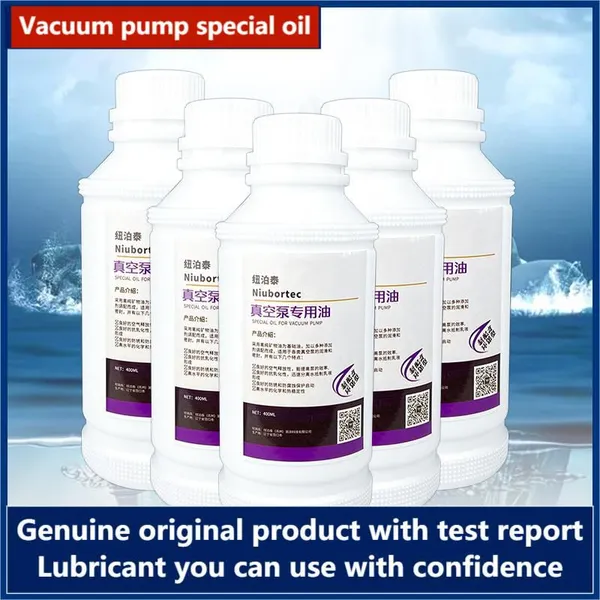
 Niubortec Vacuum Pump Oil 400ML*12NegotiableMOQ: 10 Cartons
 -
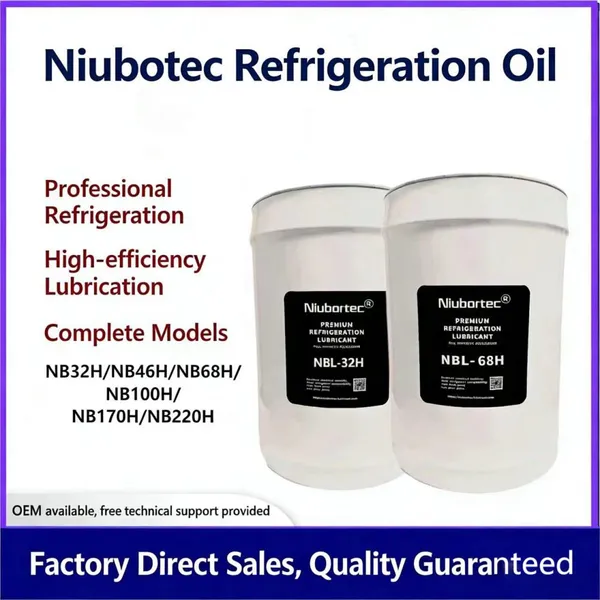
Fully Synthetic POE Refrigeration Oil 200LUS$ 1200 - 1250MOQ: 10 Barrels
-
Niubortec GS Series Mineral Refrigeration OilUS$ 824.6 - 875MOQ: 10 Barrels
-
Niubortec Fully Synthetic POE Refrigeration Oil 1LUS$ 15.6 - 18MOQ: 10 Cartons
-
Niubortec Fully Synthetic POE Refrigeration Oil 18LUS$ 157.5 - 159MOQ: 10 Cartons